

FIRST PRINCIPLES THINKING IN SOFTWARE ENGINEERING

Solve the right problem. Build the right solution.
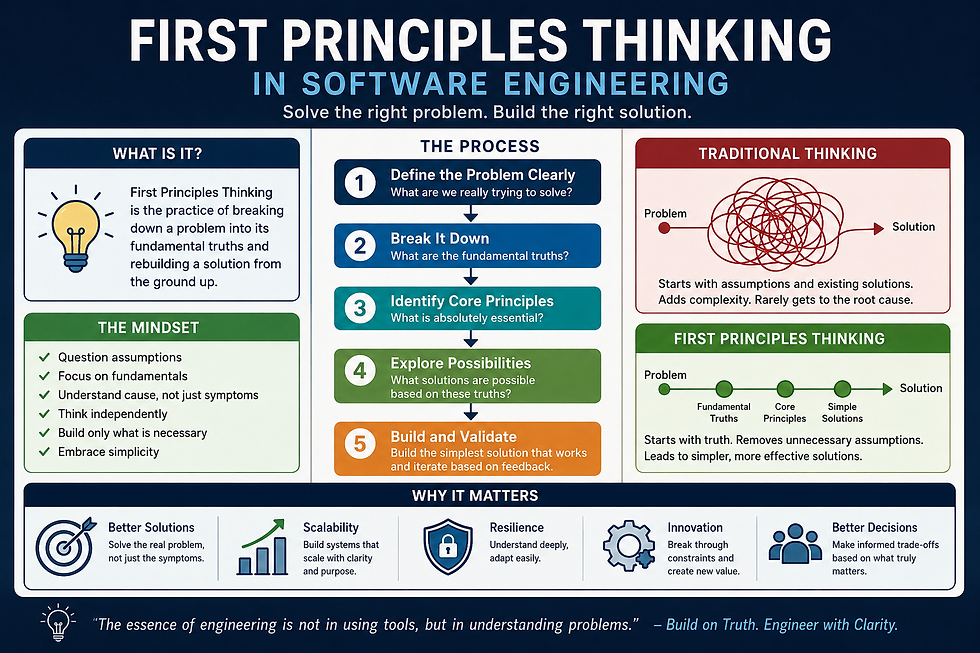
First Principles Thinking in Software Engineering
Software engineering is often mistaken for the act of writing code. In reality, code is only the visible residue of deeper intellectual processes. Behind every successful system lies a chain of reasoning, a structure of decisions, and a disciplined method of understanding problems at their core. Among the most powerful methods of reasoning in engineering is what is commonly called “First Principles Thinking.”
First Principles Thinking is the process of breaking down complex problems into their most fundamental truths and then rebuilding solutions from the ground up. Rather than relying on assumptions, traditions, patterns, trends, or inherited conventions, the engineer asks:
What is fundamentally true here?
What are the irreducible realities of this problem?
This approach is ancient in origin. Philosophers such as Aristotle spoke of first principles as the foundational truths from which knowledge proceeds. Modern engineering merely inherited and adapted this mode of reasoning into practical systems design, architecture, and innovation.
In software engineering, First Principles Thinking separates genuine engineers from mere framework operators.
Many developers today build systems by imitation. They reproduce patterns seen in tutorials, copy architectural styles from large companies, or apply technologies simply because they are fashionable. While imitation can accelerate learning, it often leads to fragile systems because the underlying reasoning is absent. Engineers who depend solely on precedent become trapped by inherited assumptions.
First Principles Thinking breaks that dependency. Instead of asking, “How do people usually build this?” the engineer asks, “What problem are we actually trying to solve?”
This distinction changes everything.
Consider a web application suffering from performance issues. A conventional approach might involve scaling infrastructure, adding caching layers, or purchasing more powerful servers because these are common solutions. A first-principles engineer begins differently. They examine the nature of the bottleneck itself.
Is the issue computational complexity?
Is the database improperly indexed?
Is the network overloaded?
Is unnecessary data being transmitted?
Are users waiting because of rendering delays?
Is the architecture itself flawed?
By reducing the problem to its underlying mechanics, unnecessary assumptions disappear. Often the simplest solution emerges only after complexity is stripped away.
This mode of thinking is especially critical in system architecture.
Large software systems naturally accumulate abstractions. Layers upon layers of services, frameworks, APIs, and dependencies are introduced over time. Eventually, teams forget why certain decisions were made. Complexity becomes institutionalized. Systems become difficult to maintain because nobody questions the original assumptions anymore.
First Principles Thinking forces engineers to periodically return to fundamentals.
What is the core responsibility of this service?
Why does this dependency exist?
Can this process be simplified?
What are the actual requirements?
Which constraints are real, and which are inherited habits?
Such questioning often reveals that entire architectural layers exist merely because “that’s how it has always been done.”
Some of the greatest advances in computing emerged precisely because someone challenged accepted assumptions.
Early computing systems assumed software had to run on physical hardware. Virtualization challenged this assumption. Traditional application deployment assumed applications must be tightly coupled to operating systems. Containers challenged this assumption.
Conventional relational systems assumed strict schemas were always necessary. NoSQL systems questioned that belief under specific scalability conditions.
Innovation rarely begins with technology itself. It begins with questioning assumptions.
However, First Principles Thinking is not rebellion for its own sake. Many inexperienced developers misunderstand it as an excuse to ignore established practices. This is dangerous. Software engineering contains hard-earned wisdom accumulated through decades of failures. Design patterns, testing methodologies, security principles, and operational disciplines exist because engineers repeatedly encountered the same problems.
The purpose of First Principles Thinking is not to reject tradition blindly. It is to understand why traditions exist.
Once the underlying reasons are understood, the engineer can determine whether those reasons still apply.
For example, a junior developer may reject layered architecture because it appears “old-fashioned.” A mature engineer studies the purpose behind it: separation of concerns, maintainability, testability, and scalability of human collaboration. Only after understanding these principles can one responsibly decide whether a simpler or alternative structure is appropriate.
Thus, First Principles Thinking requires intellectual humility.
One must be willing to admit ignorance and examine reality directly rather than relying on reputation or popularity. This is difficult because the software industry moves rapidly and rewards certainty more than careful reasoning. Engineers often feel pressure to appear knowledgeable about every new framework or architectural trend. Yet genuine understanding comes not from memorizing technologies, but from mastering fundamentals.
The strongest software engineers are usually deeply grounded in core principles:
data structures, algorithms, networking, operating systems, distributed systems, security, human-computer interaction, and computational trade-offs.
These fundamentals endure while technologies change.
A developer who understands HTTP deeply can adapt to any web framework. A developer who understands concurrency principles can work across multiple programming languages. A developer who understands databases fundamentally can reason about SQL, NoSQL, graph systems, and distributed storage architectures with clarity.
First Principles Thinking therefore produces adaptability.
This adaptability becomes essential as organizations scale. Teams frequently encounter problems with no predefined solution. At such moments, cookbook engineering fails. The engineer must reason from foundational truths.
Suppose a company processes billions of events daily and existing tools no longer scale economically. Documentation alone will not solve the problem. The engineering team must understand distributed computation fundamentally:
How does data move?
Where does contention occur?
What are the latency boundaries?
How is consistency maintained?
Which operations are CPU-bound versus IO-bound?
What are the trade-offs between availability and consistency?
These questions arise directly from first principles.
Another important aspect of First Principles Thinking is simplification.
Complexity is one of the greatest enemies of software systems. Every dependency, service, abstraction, and configuration increases cognitive load. Many engineers unintentionally create complexity because they optimize for short-term convenience or technological novelty.
First-principles engineers constantly seek simplification by identifying what is truly necessary.
A simple system is easier to debug.A simple system is easier to secure.A simple system is easier to scale.A simple system is easier for teams to understand.
This does not mean simplistic systems. Rather, it means systems where every component has a justified purpose.
The philosophy of simplicity is visible in many enduring engineering traditions. Unix tools were designed around doing one thing well. RESTful principles emphasized statelessness and clear resource boundaries. Functional programming emphasized predictable behavior through immutability and pure functions. These ideas endure because they emerge from fundamental reasoning about reliability and maintainability.
First Principles Thinking also improves leadership in engineering organizations.
Technical leaders frequently face trade-offs between deadlines, technical debt, maintainability, cost, and innovation. Leaders who reason only from precedent often become reactive. Those who reason from first principles can make clearer strategic decisions.
For example, a company may believe it needs microservices because large technology companies use them. A first-principles leader examines the actual organizational needs:
How many teams exist?
What deployment constraints exist?
How independent are business domains?
What operational maturity exists?
Will distributed complexity exceed the organization’s capacity?
The conclusion may be that a modular monolith is more appropriate. Such clarity prevents organizations from adopting architectures they cannot sustain.
Ultimately, First Principles Thinking in software engineering is a discipline of truth-seeking. It requires engineers to think clearly, question deeply, and reason independently. It demands patience in an industry obsessed with speed and trends.
The engineer who masters this discipline develops more than technical skill. They develop intellectual resilience.
Frameworks will change.
Languages will evolve.
Platforms will rise and disappear.
Architectural fashions will come and go.
But the ability to reason from foundational truths remains timeless.
That is why the greatest engineers are not remembered merely for the technologies they used, but for the clarity with which they understood problems. They saw beneath appearances. They reduced complexity to essentials. They built not upon imitation, but upon understanding.
And in software engineering, understanding is the foundation upon which all enduring systems are built.

